

Livestock farming has a carbon problem. Cattle and other livestock produce greenhouse gas emissions through digestion, manure, feed production, and everyday farm operations. As the focus on climate change grows, these emissions are becoming harder for the industry to ignore.
But there is another side to the story.
What if reducing livestock emissions could create new value for farmers? With carbon markets growing and climate-smart farming gaining attention, livestock emissions may not always be viewed only as a cost or environmental concern. They could become part of a bigger opportunity.
So, will livestock carbon emissions remain a challenge, or could they become an opportunity for the farmers who learn how to manage them?
Table of Contents
Where Do Livestock Carbon Emissions Come From?
When people talk about livestock emissions, cattle often come to mind first. And for good reason. Cattle release methane as part of their natural digestion process. But that is only one part of the picture.
Livestock emissions can come from several areas of a farm, including:
- Enteric methane: Cattle and other ruminants produce methane while digesting food.
- Manure: The storage and management of animal waste can release methane and nitrous oxide.
- Feed production: Growing, processing, and transporting animal feed also creates emissions.
- Land use: Land used for grazing and feed production can contribute to the overall carbon footprint.
- Farm operations: Energy use, transportation, equipment, and other daily activities add to emissions.
This makes livestock carbon emissions more complicated than simply counting the methane produced by a cow. A farm’s overall footprint depends on how its animals are raised, what they are fed, how waste is managed, and how the operation uses its resources.
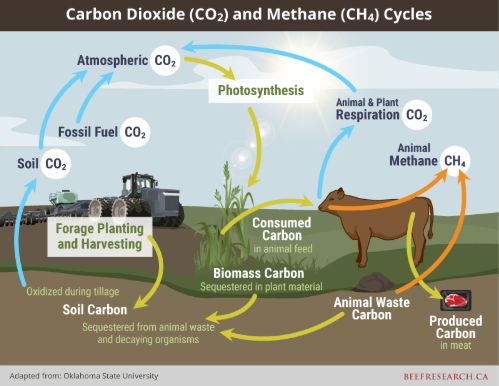
Image source: Beefresearch.ca
That is also why better livestock management matters. Before farmers can reduce emissions or explore future opportunities around them, they first need to understand what is happening across the farm.
Why Are Livestock Carbon Emissions a Challenge?
Livestock emissions are not just a climate issue. They can also become a business concern for farmers as agriculture moves toward more sustainable production.
Methane, in particular, is a major concern because it is a powerful greenhouse gas. Cattle and other ruminants naturally produce it during digestion. Manure management, feed production, and other farm activities add to the overall impact.
And this is not just a theory. Research from the Food and Agriculture Organization (FAO) has helped put the scale of the issue into perspective. Its work on livestock emissions shows that livestock supply chains are responsible for a significant share of human-caused greenhouse gas emissions. More importantly, the impact can vary depending on how animals are fed, managed, and how efficiently the farm operates.
That makes the issue a little more complicated than simply saying that livestock produces emissions. For farmers, the real challenge is figuring out where those emissions are coming from and what can actually be done about them.
They may also need to respond to changing consumer expectations, sustainability standards, future regulations, and growing pressure across food supply chains.
There is another practical problem: it is difficult to manage what you cannot measure.
Many farms still have limited access to detailed information about their livestock operations. Without good records, it becomes harder to understand where resources are being wasted, where emissions may be coming from, or whether a new farming practice is actually making a difference.
That makes better farm data an important part of the solution. And perhaps, the first step toward turning a challenge into an opportunity.
But Could Reducing Livestock Carbon Emissions Become an Opportunity?
A problem does not always have to stay a problem. Sometimes, it can create a new opportunity.
The livestock emissions conversation deserves attention in this regard. . As carbon markets grow and more businesses look for ways to reduce their environmental impact, farmers may have new ways to create value from better environmental practices.
For example, changes in animal feed, manure management, grazing practices, and overall farm efficiency can potentially reduce emissions. In some cases, verified emission reductions may also become part of carbon-credit projects.
But there is an important catch.
Reducing emissions does not automatically mean earning carbon credits. A project needs to meet specific requirements, use an accepted methodology, measure its impact, and go through the required validation or verification process. There also needs to be a market willing to buy the credits.
There are already organizations around the world helping finance, develop, verify, and trade carbon projects. Names such as South Pole, 3Degrees, STX Group, and Germany-based UPM show how much of the carbon-finance infrastructure has developed outside emerging agricultural markets. UPM, for example, has worked across Asia, the Middle East, Africa, and Latin America, supporting projects from development and investment to carbon-credit trading.
For farmers and landowners in regions like South Asia, however, the path into these markets can still feel distant. The land and agricultural potential are here. What is often missing is the infrastructure that connects local projects with international climate finance.
And that gap is interesting. Because if better livestock and agricultural practices can create measurable environmental benefits, the question is no longer just how much carbon a farm can reduce.
It becomes: who can help turn that measurable impact into something financially valuable?
What Would Farmers Need to Do First?
The idea of earning from carbon reduction sounds exciting. But before a farm can enter that conversation, there is some basic work to do.
The first step is knowing what is happening on the farm.
How many animals are there? What are they being fed? How is manure being managed? How much land and water are being used? Are animals gaining weight efficiently? Which practices are helping, and which ones are creating unnecessary costs?
These may sound like ordinary farm-management questions. But they can become much more important when environmental performance enters the picture.
A carbon project needs evidence. Farmers need to be able to show what they were doing before a change, what they changed, and what happened afterward. Without reliable records, proving an improvement can become difficult.
This is where good livestock management can make a difference.
Keeping accurate animal records, tracking farm activities, monitoring resources, and understanding livestock performance can give farmers a much clearer picture of their operation. Over time, that information can also help identify areas where emissions and costs may be reduced.
Carbon finance may still be a developing opportunity for many livestock farmers. But better farm management is useful whether a carbon market exists or not.
And that is something farmers can start working on today.
Ready to Manage Your Livestock Smarter?
Better livestock management starts with better information. With Soluta, you can keep your cattle records organized, track important livestock information, and get a clearer view of your farm operation.
Frequently Asked Questions
Can farmers in Bangladesh earn carbon credits?
No, not yet. But farmers in Bangladesh can participate in carbon-credit projects if their activities meet the requirements of a recognized carbon standard and the project can demonstrate measurable, additional emission reductions or removals. Access to suitable project developers, verification, and buyers is also important.
Does Bangladesh have accredited organizations for carbon credits?
Bangladesh has organizations working on climate finance, carbon projects, sustainability, and environmental services. However, farmers should check whether an organization is officially accredited or works with a recognized carbon standard before entering a carbon-credit agreement.
How can I calculate carbon emissions on my farm?
Farm emissions can come from several sources, including livestock digestion, manure, feed production, energy use, transportation, and land management. A proper calculation usually requires farm-specific activity data and an accepted emissions methodology. For a carbon-credit project, the calculation may also need independent validation or verification.
How many carbon credits can one cow generate?
There is no fixed number. The potential carbon-credit value depends on the animal, farming system, baseline emissions, the reduction or removal achieved, the project methodology, and whether those reductions qualify under a recognized carbon standard.
Can small livestock farms participate in carbon-credit projects?
They can, but participating individually may be difficult because measuring, documenting, and verifying emissions can be expensive. Some projects solve this by grouping many small farms into a larger program, allowing the combined impact to be measured and managed.
What livestock practices can help reduce carbon emissions?
Better feed efficiency, improved manure management, animal health, grazing practices, and more efficient farm operations can all play a role. The right approach depends on the type of livestock operation and local farming conditions.
Who buys livestock carbon credits?
Potential buyers include companies seeking to meet voluntary climate commitments, carbon-market participants, and organizations looking to support verified emission-reduction projects. The type of credit and the standard behind it can affect who is willing to buy it.
Is carbon credit income guaranteed for farmers?
No. Carbon-credit income is not guaranteed. A project needs to meet specific requirements, and the resulting credits need to have market demand. Project development, verification, transaction costs, and credit prices can also affect how much a farmer may ultimately receive.
What records should livestock farmers keep for future carbon projects?
Farmers should keep reliable records of livestock numbers, animal types, feed, manure management, land use, farm inputs, energy use, and relevant production activities. Good records can make it much easier to establish a baseline and demonstrate changes over time.
Final Thoughts
Livestock emissions are a real challenge. There is no point pretending otherwise.
But perhaps the more interesting part of the conversation is what comes next.
As agriculture becomes more focused on sustainability, the way farmers manage their animals, resources, and emissions could become increasingly valuable. Carbon markets may create opportunities in the future, but those opportunities will depend on something much more basic: good farming data and better farm management.
A farmer cannot manage what they cannot see. And they cannot prove an improvement they never recorded.
So, the journey from livestock emissions to potential financial opportunity may not start with a carbon credit. It may start with knowing your cattle better, keeping better records, and understanding what is happening across the farm.
The carbon economy is still evolving. But the farms that start becoming more organized and data-driven today may be in a much better position to take advantage of what comes next.
The challenge is here. The opportunity may be too. The first step is simply being ready for it.
Have Questions About Livestock, Carbon, or Farm Management?
Every farm is different, and so are the challenges that come with it. If you have questions about Soluta, livestock management, or how better farm data can support your operation, we’d be happy to hear from you.
Talk to Soluta →