
Farming is no longer just about soil, seeds, and seasons. It’s about numbers. Cash flow. Risk. Market timing. Modern farmers are running businesses, not just fields. But most financial systems still treat agriculture like it’s stuck in the past. That gap is growing fast.
So what is agrifintech, and why are people talking about it? In simple terms, agrifintech blends agriculture with financial technology. It uses digital tools to help farmers access credit, manage payments, track income, and make smarter financial decisions.
In this article, we’ll break down what agrifintech means, how it works, what problems it solves, and why it matters for modern farmers navigating today’s economic and climate challenges.
Table of Contents
What Is Agri-FinTech?
Agrifintech is the intersection of agriculture and financial technology. It combines farm operations with digital financial systems to make money management easier, faster, and smarter for farmers.
Traditionally, farmers relied on local banks, informal lenders, or delayed buyer payments. The process was slow, paperwork-heavy, and often risky. Agrifintech changes that by introducing mobile apps, digital payments, automated bookkeeping, alternative credit scoring, and data-driven lending.
In short, agrifintech helps farmers access capital, track financial performance, manage transactions, and reduce risk using technology.
Why Is Agri-FinTech Becoming So Important Today?
Farmers are under pressure. Cash flow is unpredictable. Payments from buyers are often delayed. Input costs keep rising. And getting formal credit is still hard, especially for smallholders.
Many farmers lack collateral, formal records, or credit history. According to the World Bank, limited access to finance remains one of the biggest barriers to agricultural growth in developing economies.
That’s where agrifintech steps in. It uses transaction data, farm records, and digital footprints to assess creditworthiness. Instead of relying only on collateral, platforms evaluate behavior and performance. In simple terms, agrifintech turns farm data into financial opportunity.
So, overall, It shortens loan approval time, improves transparency, and gives farmers more control over their money.
What Problems Does Agri-FinTech Solve for Modern Farmers?
Agrifintech is not just a buzzword. It directly targets the financial bottlenecks farmers face every season. From credit access to payment delays, it simplifies systems that used to be slow and complicated.
Getting Loans Easier and Faster
Traditional banks often require heavy paperwork and physical visits. Agrifintech platforms use digital records and alternative credit scoring to assess risk. This makes loan approvals faster and more inclusive. Farmers who were previously invisible to formal lenders can now access structured financing.
Simplifying Payments and Transactions
Many farmers still deal with cash-based systems. This increases risk and reduces traceability. Agrifintech enables digital payments, supplier transfers, and buyer settlements through secure platforms. Payments become faster, safer, and easier to track.
Improving Financial Tracking and Visibility
A major issue in farming is the lack of structured financial records. Agrifintech platforms allow farmers to monitor income, expenses, profit margins, and outstanding payments in one place. Clear data leads to better decisions.
Reducing Risk Through Data
By analyzing crop cycles, historical performance, and transaction patterns, agrifintech tools can help predict financial gaps and risks. This improves planning and reduces surprises during critical farming seasons.
How Does Agri-FinTech Actually Work?
At its core, agrifintech runs on data, connectivity, and automation. It connects farm operations with digital financial systems through mobile apps, cloud platforms, APIs, and AI-based analytics. Every transaction, crop cycle, input purchase, and sales record becomes data. That data is then analyzed to assess credit risk, forecast cash flow, and automate financial workflows.
Alright, behind the scenes, cloud infrastructure stores and processes this information securely. AI models evaluate patterns. APIs connect banks, buyers, suppliers, and farmers in one digital ecosystem. The system works in real time. No physical files. No long approval chains.
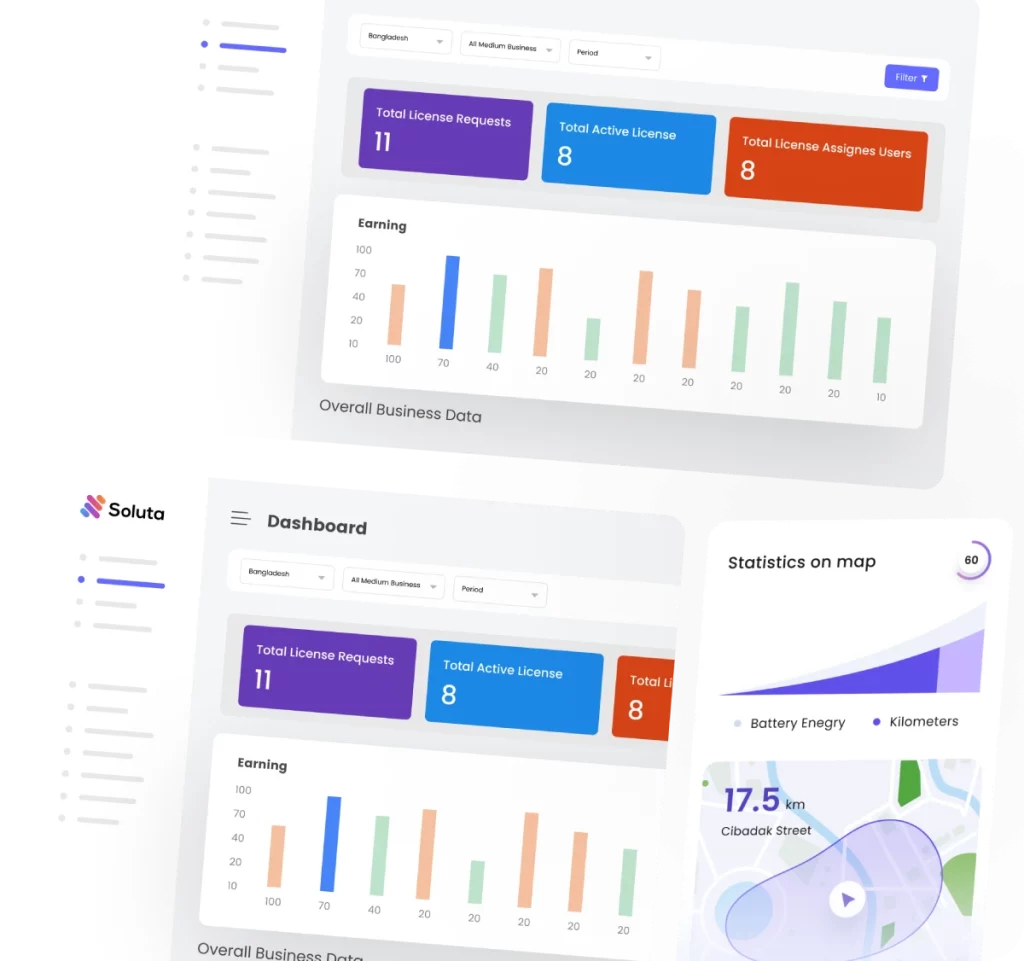
For farmers, the technical complexity stays invisible. What they see is simplicity. Faster loan approvals. Instant payment confirmations. Clear dashboards showing income, expenses, and pending dues. Easy but effective!
How Do Mobile Apps and Cloud Platforms Support Farmers?
Mobile apps make agrifintech accessible even in rural areas. A farmer can apply for credit, track payments, upload documents, or monitor transactions directly from a smartphone. There is no need to travel long distances to a bank branch.
Cloud platforms ensure that data is always available and synchronized. Whether a farmer is in the field or at home, financial records remain updated and secure. Even cooperatives and agribusinesses can access shared dashboards for better coordination.
In simple terms, mobile brings access. Cloud brings reliability. Together, they reduce friction, save time, and give farmers financial control at their fingertips.
Understanding the Agri-FinTech Ecosystem
Agrifintech doesn’t just help farmers. It strengthens the entire agricultural value chain. When financial systems become digital, transparent, and connected, everyone involved in production, distribution, and financing benefits.
Here’s how the ecosystem looks:
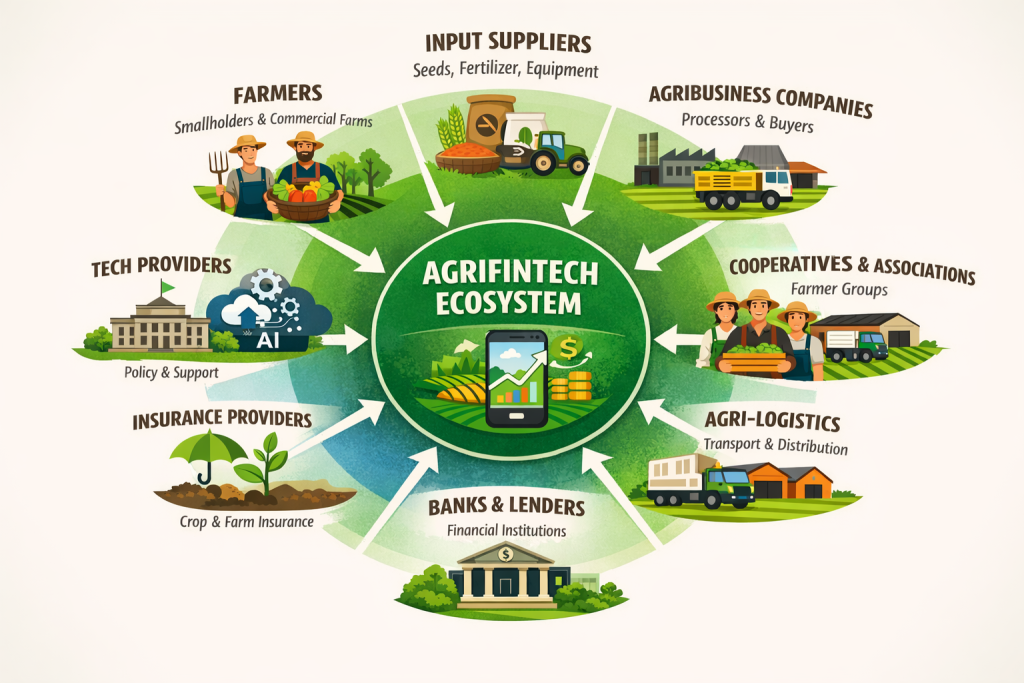
Image Archive: the Agrifintech Ecosystem
Farmers (Smallholders and Commercial Farms)
They gain faster access to credit, better cash flow management, digital payments, and real-time financial tracking. This improves planning, reduces dependency on informal lenders, and increases profitability.
Agribusiness Companies
Large buyers and processors benefit from structured payment systems, verified transaction records, and improved supplier transparency. It reduces default risk and improves procurement efficiency.
Input Suppliers (Seeds, Fertilizer, Equipment Dealers)
With digital financing and payment systems, suppliers get paid faster. Some platforms even enable “buy now, pay later” models for farmers, backed by credit scoring systems.
Cooperatives and Farmer Associations
They gain visibility into member transactions, production volumes, and repayment patterns. This improves group financing and strengthens collective bargaining power.
Financial Institutions and Lenders
Banks and microfinance institutions can assess risk using real farm data instead of limited paperwork. Alternative credit scoring expands their customer base while lowering default rates.
Agri-Logistics and Distributors
When payments and contracts are digitized, logistics providers face fewer delays. Transparent systems improve coordination between farms, warehouses, and markets.
Insurance Providers
With access to crop data and transaction history, insurers can design smarter agricultural insurance products and process claims more efficiently.
Governments and Policy Makers
Digitized financial records improve subsidy targeting, tax reporting, and agricultural planning. It increases accountability and reduces leakage.
Technology Providers
Software platforms, data analytics firms, and AI developers become core enablers of the agri-financial ecosystem.
Why Soluta Is Perfect for the Entire Agri-Fintech Ecosystem
Agrifintech works best when everything is connected. Not just loans. Not just payments. But the full financial and operational flow of agriculture. That’s where Soluta stands out.
Soluta is designed as an AI-powered agrifintech platform that supports farmers, agribusinesses, cooperatives, and financial partners in one structured system. It doesn’t isolate financial services. It integrates them with real farm operations.
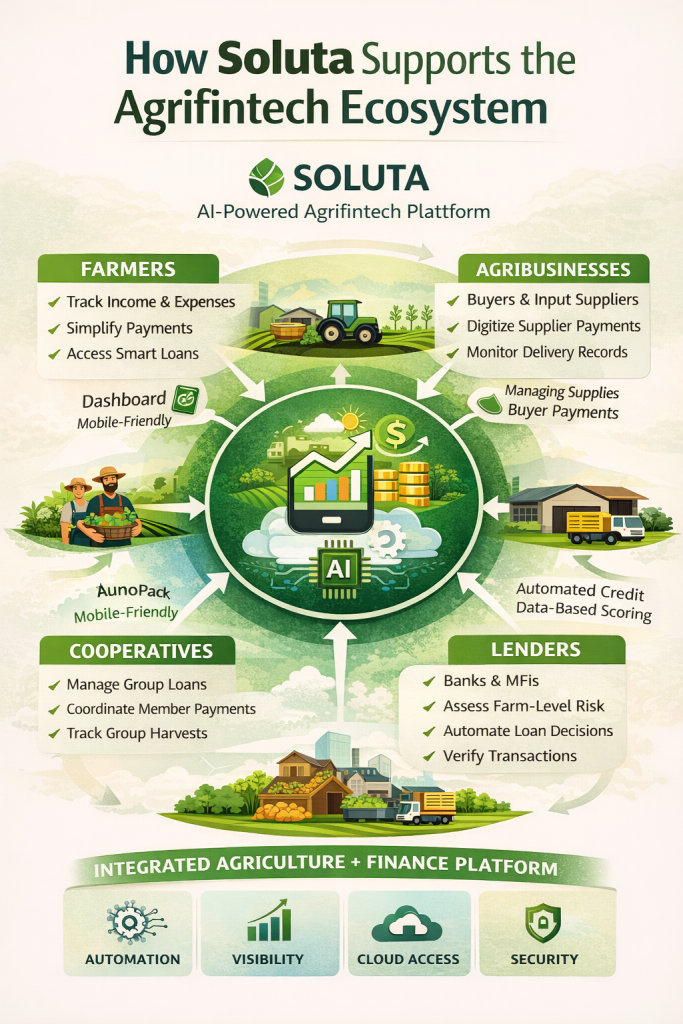
For farmers, Soluta helps track income, expenses, input costs, and sales in one place. This builds financial clarity. With structured records, accessing credit becomes easier and more data-backed.
For agribusinesses and buyers, Soluta brings visibility into supplier transactions and payment cycles. That improves coordination and reduces risk.
For lenders and partners, Soluta enables data-driven evaluation instead of relying only on paperwork. Real farm performance becomes measurable.
And because it runs on cloud infrastructure with mobile accessibility, the entire ecosystem stays connected in real time. No silos. No delays.
In simple terms, Soluta doesn’t just digitize agriculture. It connects the financial heartbeat of the entire agricultural supply chain.
Get Smarter Agricultural Insights With Soluta
Monitor weather, reduce risks, improve farm decisions, and stay ahead with AI-driven agricultural intelligence.
Download the AppFAQs
Q: Is agrifintech only useful in developing countries?
No. While agrifintech plays a major role in improving financial inclusion in developing regions, it is equally relevant in advanced agricultural economies. Even large-scale farms in developed countries use digital finance tools for risk analysis, supply chain coordination, and automated reporting.
Q: Do farmers need advanced technical skills to use agrifintech platforms?
Not necessarily. Most agrifintech apps are designed to be mobile-friendly and user-focused. The goal is simplicity. If a farmer can use a smartphone for messaging or payments, they can usually navigate a well-designed agrifintech platform.
Q: How secure is the financial data stored in agrifintech systems?
Reputable agrifintech platforms use cloud security, encryption, and controlled access systems. Data protection is a core part of their infrastructure. In many cases, digital records are safer and more traceable than paper-based systems.
Q: Can agrifintech work in areas with limited internet connectivity?
Many platforms are optimized for low-bandwidth environments. Some even offer offline data entry that syncs when connectivity is restored. Mobile-first design is critical for rural accessibility.
Q: How does agrifintech impact long-term farm growth?
By creating structured financial records and improving credit access, agrifintech helps farmers build financial credibility over time. This can unlock larger investments, better partnerships, and stronger positioning in the agricultural value chain.
Final Words
Agrifintech represents a major shift in how agriculture and finance work together. Modern farmers need more than traditional banking. They need speed, clarity, and data-driven support. Throughout this article, we explored how agrifintech improves credit access, simplifies payments, and strengthens the entire agricultural ecosystem.
When financial systems become smarter, farmers gain confidence, businesses operate smoothly, and supply chains grow stronger. Agrifintech isn’t just innovation. It’s becoming the financial backbone of modern farming.