
Agro enterprises sit at the center of food security, rural income, and economic stability. Yet behind every harvest is a complex system of planning, logistics, labor, finance, and risk management. When even one part breaks down, the entire operation feels the pressure. From weather shocks to delayed payments, the stakes are high. Growth sounds simple on paper. In reality, operations often struggle long before scale becomes possible.
So, what are operational challenges in agro business? They are the everyday obstacles that slow productivity and reduce profit. Poor data visibility, manual reporting, climate volatility, disconnected supply chains, and limited access to finance all fall into this category.
This article explores how integrated platforms reduce operational challenges in agro business by connecting data, improving decision-making, and building smarter, more resilient agro enterprises.
Table of Contents
Why Traditional Agro Operations Struggle to Scale
Traditional agro operations rely heavily on manual systems and fragmented processes. Field data is recorded on paper. Reports are compiled late. Decisions are reactive instead of proactive. By the time insights reach leadership, the opportunity has often passed.
Another major issue is disconnected communication. Farmers, suppliers, transporters, insurers, and buyers operate in silos. Without a shared system, coordination becomes slow and error-prone. Small inefficiencies multiply across the chain.
Weather uncertainty adds another layer of pressure. Without predictive insights, planning remains guesswork. Input costs rise. Output becomes unpredictable. Financial risk increases.
Scaling requires visibility, automation, and coordinated intelligence. Traditional models rarely provide that foundation.
3 Most Critical Operational Challenges in Agro Business Today
Agro enterprises are not failing because of lack of effort. They struggle because the system around them is fragmented. The risks are real. The margins are tight. And one weak link can affect the entire season.
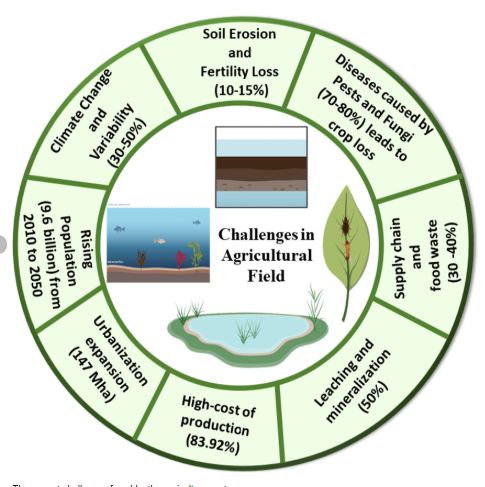
Image Collected from Researchgate
Supply Chain Inefficiencies
Even when production succeeds, logistics can fail. Delayed transport. Poor storage. Lack of real-time inventory data. Manual tracking.
A small delay at one point creates losses down the line. Perishable goods spoil. Buyers lose trust. Operational costs rise.
Disconnected supply chains don’t just slow growth. They eat into profit silently.
Poor Risk Visibility for Lenders and Insurers
Financial institutions want data. They want measurable risk.
Without clear visibility, lenders hesitate. Insurers increase premiums. Claims take longer to process. Trust remains limited. The result ends in higher financial friction for everyone involved.
Limited Financial Inclusion for Farmers
Many farmers still operate outside formal financial systems. No structured records. No reliable credit history. No digital performance tracking.
This blocks access to affordable loans, insurance products, and growth capital. The business remains small, not because of ambition, but because of system limitations.
Data Silos Across Stakeholders
Field data sits with farmers. Procurement data sits with buyers. Weather data sits somewhere else. Insurance data stays locked in another system.
If there’s no unified intelligence, decision-making slows down. Errors increase. And scaling becomes complex.
What Is an Integrated Platform in Agribusiness?
An integrated platform in agribusiness is a centralized digital system that connects operations, finance, weather intelligence, supply chains, and stakeholders into one unified environment.
Instead of scattered tools and spreadsheets, everything runs through a shared infrastructure.
It typically includes:
- Centralized dashboards for real-time operational visibility
- Automated workflows for field and back-office tasks
- Real-time analytics for production and risk insights
- Cross-stakeholder connectivity between farmers, enterprises, lenders, and insurers
Case Insight: How Soluta Is Redefining Operational Efficiency in Agro Enterprises
Soluta is just one example of this shift toward integrated intelligence. It’s an AI-powered platform designed to reduce operational uncertainty across agro ecosystems. Rather than functioning as a simple management tool, Soluta operates as a connected intelligence layer that brings together risk visibility, climate data, insurance workflows, and operational analytics in one structured system.
Dynamic Risk Assessment
At its core, Soluta combines dynamic risk scoring with real-time weather intelligence. Instead of treating risk as a vague possibility, the platform translates environmental patterns, production behavior, and operational data into measurable insights. Agro enterprises gain a clearer understanding of exposure before losses occur. That alone changes how planning decisions are made.
Easy Insurance
The platform also facilitates data-driven insurance processes. By continuously recording operational data, Soluta reduces the friction that often surrounds claims and risk assessment. When an event occurs, information is already structured and available within the system.
There is no dependency on manual bank paperwork or disconnected documentation chains. Claims move through a digital pathway, reducing administrative burden and saving time when it matters most.
The Analytics
Operational analytics further strengthen this ecosystem. Enterprises can monitor performance trends, identify bottlenecks, and adjust strategies using real data rather than assumptions. Weather forecasts inform production timing. Risk indicators guide financial planning. Stakeholders operate with shared visibility.
What makes Soluta different is not just the technology itself, but the role it plays. It functions as infrastructure. It connects farmers, enterprises, insurers, and financial institutions within one intelligent framework. Instead of adding another layer of complexity, it simplifies coordination.
The Strategic Advantage of AI-Powered Agro Platforms
AI-powered agro platforms give enterprises something agriculture has always struggled with – clarity ahead of time. Instead of reacting to crop loss, price drops, or logistics failures, businesses can anticipate patterns and adjust early.
Large Data, Instant Insights
Artificial intelligence processes large volumes of weather data, soil conditions, yield records, and market signals in seconds. What would take weeks of manual review becomes instant insight. This allows managers to allocate inputs more efficiently, optimize planting cycles, and reduce waste across operations.
Precision in Risk Management
Another strategic edge is precision in risk management. AI models detect anomalies, flag potential disruptions, and improve forecasting accuracy. Financial partners also benefit. When operational data is structured and continuously updated, lending and insurance decisions become more data-driven and less speculative.
Most importantly, AI creates consistency. Decisions are no longer dependent only on experience or instinct. They are supported by measurable indicators. Over time, that consistency builds operational discipline and long-term stability.
In a sector where margins are thin and volatility is high, that strategic advantage becomes a competitive differentiator.
The Future of Operational Management
Operational management in agro business is moving toward full ecosystem connectivity. The future is not about isolated tools. It is about intelligent networks where production, finance, logistics, and risk management operate in alignment.
Predictive analytics will become standard rather than optional. Climate modeling will influence planting strategies months in advance. Supply chains will become traceable from field to final buyer. Financial services will embed directly into operational platforms, reducing paperwork and delays.
Decision-making will increasingly rely on real-time dashboards rather than periodic reports. Enterprises will adjust strategies dynamically, based on live data streams instead of seasonal reviews.
Most importantly, resilience will define success. Agro enterprises that combine operational intelligence with financial and environmental insight will be better prepared for volatility.
The future of operational management is not just digital. It is integrated, predictive, and adaptive. Those who embrace that model will not only reduce operational challenges in agro business — they will redefine how agricultural enterprises grow.
Final Words
Operational challenges in agro business are not new, but the way they are being addressed is changing fast. Integrated platforms are helping enterprises replace fragmented processes with clearer visibility, better coordination, and smarter decisions. When weather intelligence, operational data, and financial systems work together, uncertainty becomes easier to manage.
The goal is not to remove every risk, but to build systems that respond faster and plan better. As agriculture continues to evolve, those who embrace connected and intelligent operations will find themselves better prepared for the seasons ahead.