
Farming has always been a bet against the sky. Months of hard work can slip away for one wrong rain, one sudden heatwave. Weather is not just background noise but the main character in agriculture.
So what is weather intelligence in farming, and how does it really impact decision making? In simple terms, it’s the use of real-time data, smart forecasting, and predictive tools to help farmers make better, faster choices. Instead of guessing what might happen, farmers can act based on patterns, probabilities, and insights backed by data.
This article breaks it down in a clear way. We’ll look at what weather intelligence really means in modern agriculture, why traditional forecasting no longer cuts it, and how smarter weather insights are shaping daily farm decisions; from planting to harvesting and everything in between.
Table of Contents
What Is Weather Intelligence in Farming?
Weather intelligence is more than checking tomorrow’s forecast. It’s a data-driven system that collects, analyzes, and predicts weather patterns to guide farming operations.
At a technical level, it combines satellite data, IoT-based field sensors, radar systems, historical climate records, and AI-powered analytics. These systems process huge amounts of data in real time. They don’t just tell you it might rain. They estimate how much rain, when it will start, how long it will last, and how it will affect soil moisture, crop stress, or disease risk.
In easy words, weather intelligence turns raw weather data into farm-level action steps.
For example:
Instead of hearing “rain expected this week,” a farmer can know:
- Rain likely in 36 hours
- Soil moisture will rise by 18%
- Irrigation can be delayed
- Fungal risk may increase in low-lying plots
That’s a big shift.
And this is not a local trend but global. From large corn farms in the Midwest to rice fields in South Asia, growers are using digital platforms to manage weather risks. Climate volatility is rising worldwide. Seasons are less predictable. So data-backed decisions are becoming a necessity, not a luxury.
Weather intelligence connects local farms to global climate data. It blends hyperlocal insights with global weather systems. That’s what makes it powerful.
Why Traditional Weather Forecasting Is No Longer Enough
Traditional weather forecasting was built for general audiences. It tells cities and regions what might happen. But farming needs precision. A five-mile difference can mean different rainfall patterns. A two-degree shift can change pest behavior.
That’s where traditional forecasts fall short.
- First, they are too broad. Regional reports don’t reflect microclimates within individual farms. One section of land may stay dry while another floods.
- Second, they are not action-focused. A forecast may say “high humidity.” But it won’t tell a farmer that this humidity increases the risk of powdery mildew in tomatoes within 48 hours.
- Third, they are not predictive in a farming sense. They describe the weather. They don’t translate it into crop-level impact.
Today’s farming moves faster. Input costs are higher. Margins are tighter. Labor is limited. Farmers need insights that speed up decisions, not slow them down.
Modern weather intelligence tools provide:
- Hyperlocal data instead of regional averages
- Hour-by-hour updates instead of daily summaries
- Predictive alerts instead of passive information
- Risk scoring for crops, pests, and diseases
It’s not about replacing weather forecasts. Think of it like upgrading them into decision tools.
In today’s agriculture, waiting for a generic forecast is like driving with a paper map. Weather intelligence is GPS. And in farming, precision wins.
How Weather Intelligence in Farming Improves Crop Planning Decisions
Crop planning used to depend on experience, local memory, and seasonal assumptions. That still matters. But now, devices and apps add another layer, data-backed clarity.
Modern weather intelligence platforms connect farm sensors, satellite feeds, and AI-based forecasting models into one dashboard. A farmer can open an app and see soil temperature, rainfall probability, evapotranspiration rate, wind speed, and even disease risk levels for specific crops. It’s technical behind the scenes, but simple on the screen.
Here’s how that improves crop planning.
First, planting timing becomes precise. Many crops need a specific soil temperature range for proper germination. Instead of guessing based on calendar dates, a smart weather system tracks soil heat units and signals the ideal planting window. This reduces poor germination and uneven growth.
Second, crop selection becomes smarter. If seasonal forecasts show a higher chance of drought or heatwaves, farmers can shift toward drought-tolerant varieties. If long-term climate models suggest excess rainfall, they may choose crops that resist waterlogging. This is not speculation. It’s predictive modeling based on regional climate patterns.
Third, risk mapping changes everything. Advanced apps can simulate “what-if” scenarios. For example:
- What happens if rainfall drops 20% this season?
- How will yield respond if heat stress days increase?
Using historical weather data and crop response models, the system estimates possible outcomes. That helps farmers diversify crops or adjust planting density before the season even starts.
Globally, precision agriculture adoption has increased rapidly over the past decade. Reports from organizations like the Food and Agriculture Organization highlight how digital climate services improve resilience in climate-sensitive regions. Weather intelligence tools are now part of national agricultural modernization programs in many countries.
In short, crop planning is shifting from reactive to predictive. Instead of adjusting after damage happens, farmers plan ahead using probability-based insights. That’s a powerful upgrade.
How Weather Data Impacts Irrigation and Water Management
Water is one of the most expensive and limited inputs in farming. Too little water reduces yield. Too much water damages roots and wastes resources. Weather intelligence helps find the balance.
Advanced systems combine short-term weather forecasts, long-term climate models, and real-time soil moisture sensors. Together, they answer one simple question: when and how much should we irrigate?
For example, if a forecast predicts rainfall within the next 24 hours, an intelligent irrigation system can delay watering. If high temperatures and strong winds are expected, the system may increase irrigation slightly to offset evapotranspiration loss.
Does Macro Level Forecasting Still Matter?
Yes, macro-level forecasting also matters. Seasonal climate outlooks like those influenced by El Niño or La Niña patterns help farmers anticipate drought or excess rainfall months in advance. That allows better reservoir planning, water storage decisions, and crop selection adjustments.
Research supports this shift. Studies show that climate-smart irrigation technologies can reduce water use by up to 30% while maintaining or even improving yield levels. In regions adopting sensor-based irrigation and predictive weather tools, water efficiency has significantly improved over recent years.
Smart irrigation systems also integrate with automated valves and drip networks. When connected to weather intelligence platforms, they adjust in real time.
Risk Assessment for Weather Intelligence in AI
Beyond efficiency, there’s risk management. Weather alerts can warn farmers about incoming storms, heavy rainfall, or frost events. In flood-prone areas, early alerts allow farmers to clear drainage channels. In drought-prone zones, they can activate water-saving strategies before stress hits crops.
Climate volatility is increasing. Rainfall patterns are less predictable. Traditional irrigation schedules, like watering every three days might not work as reliably anymore.
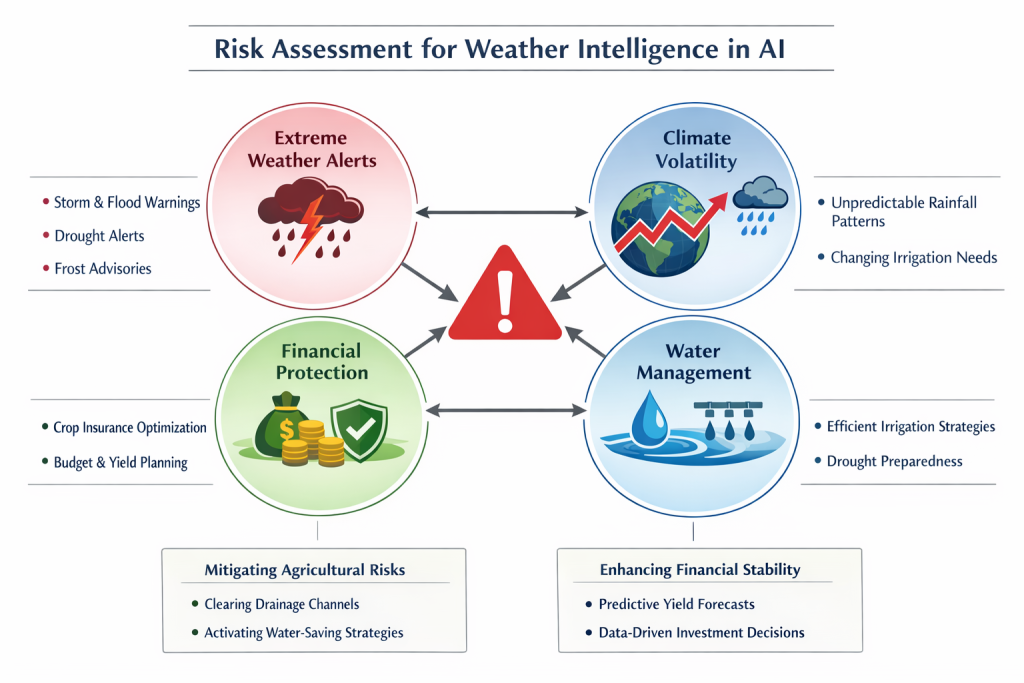
Image archive: Risk Assessment for Weather Intelligence in AI
Weather intelligence also protects money. Farming is capital-intensive. Seeds, fertilizers, labor, fuel, all paid upfront. A single climate shock can disrupt cash flow. Seasonal forecasts help in deciding whether to scale production up or reduce exposure. It also improves crop insurance planning, as risk levels become data-driven.
Lenders and agribusiness partners increasingly rely on climate analytics to assess stability. In short, weather intelligence turns uncertainty into measurable financial strategy.
Challenges in Adopting Weather Intelligence Solutions
Weather intelligence sounds powerful. And it is. But adopting it across global farming systems is not simple.
Cost
The first big challenge is cost. Many smallholder farmers in developing countries cannot afford advanced sensors, subscription-based platforms, or smart irrigation systems. Even when apps are free, devices and connectivity are not. The solution? Governments, NGOs, and agritech companies need to build low-cost, mobile-first platforms. Shared community weather stations and cooperative-based tech models can also reduce individual costs.
Digital Illiteracy
Not every farmer is comfortable reading dashboards filled with charts, risk maps, and probability scores. If the tool feels complicated, it won’t be used. The fix is simple design. Weather intelligence apps must translate complex data into clear action steps. Instead of graphs, give direct advice like “Delay irrigation for 24 hours” or “High fungal risk in 2 days.”
Connectivity
Connectivity is another barrier. Many rural areas still struggle with stable internet access. Real-time weather systems depend on strong networks. Offline-compatible apps, SMS-based alerts, and lightweight data systems can help bridge that gap.
Data Accuracy
Data accuracy is also a concern. In some regions, weather stations are sparse. That makes hyperlocal forecasting less reliable. Expanding localized sensor networks and combining satellite data with ground data can improve precision over time.
Trust
Trust is the final hurdle. Farmers often rely on experience passed down through generations. If digital forecasts contradict traditional knowledge, hesitation is natural. The solution is not replacement—but integration. Weather intelligence should support farmer experience, not dismiss it.
Adoption will take time. But with better design, lower costs, stronger infrastructure, and education programs, weather intelligence can become accessible to farmers everywhere. The goal is simple: make smart climate decisions possible for every farm, not just large-scale operations.
How Soluta Help Farmers with Weather Intelligence?
Soluta connects weather intelligence with real farm operations.
Here’s how we help
- Real-Time Weather Dashboard: Access hyperlocal forecasts, rainfall probability, temperature shifts, and risk alerts in one simple interface.
- AI-Based Risk Alerts: Storm, drought, and frost warnings translated into action steps.
- Smart Irrigation Insights: Integrate soil moisture data and forecast models to optimize watering schedules and reduce waste.
- Financial Risk Mapping: Seasonal climate outlooks linked with production planning, helping farmers manage investment exposure and insurance decisions.
- Data-Driven Planning Tools: Scenario modeling for crop cycles, yield expectations, and climate variability impact.
Ready to Make Weather a Strategic Advantage with Soluta?
Final Words
As climate patterns grow more volatile, weather intelligence will move from helpful tool to essential infrastructure. With stronger AI models, better satellite coverage, and deeper farm-level data integration, decision-making will become faster and more precise.
The challenge will be accessibility, affordability, and trust across small and large farms alike. Yet the potential is powerful. Weather intelligence can build resilient food systems, protect farmer income, and reduce global risk. The future of farming will not fight the weather, it will understand it.