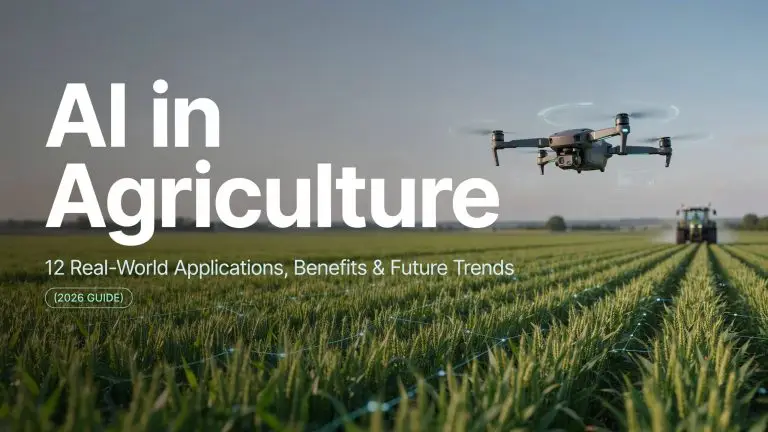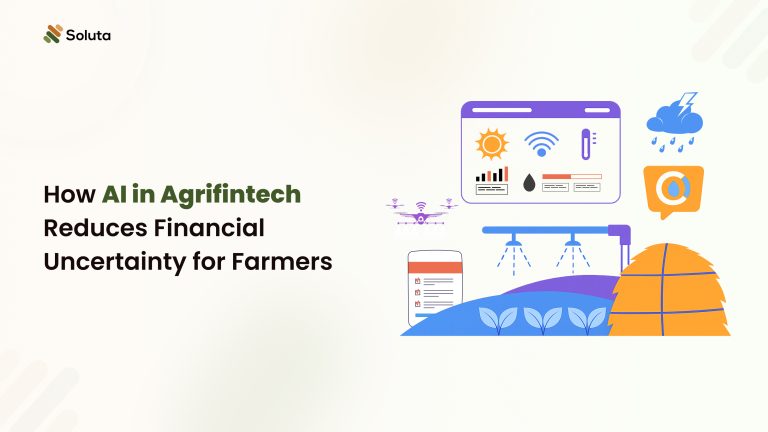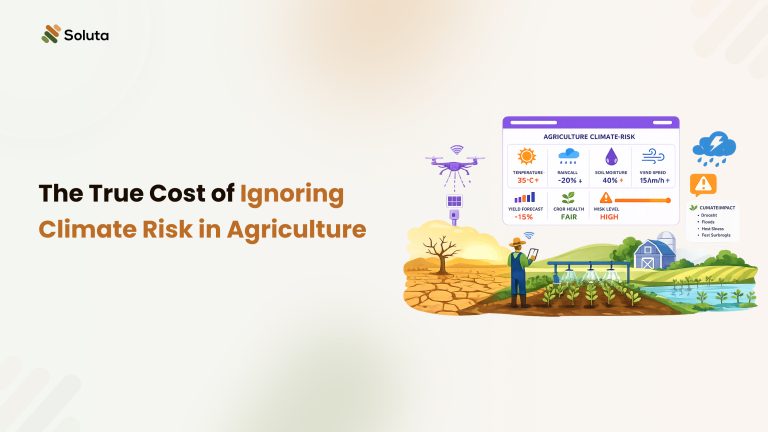

AI in Agriculture is no longer a trend. It’s not hype. It’s not a “nice to have.” It’s becoming survival.
Farming is changing fast. The weather is unstable, costs are rising, labor is shrinking, and margins are tight. And data? It’s everywhere.
Artificial Intelligence in agriculture steps into that chaos and brings structure, insight, and prediction. The future of agro business will not be built on guesswork. It will be built on data.
Let’s break this down clearly.
Table of Contents
How AI in Agriculture Reshapes the Future (in 1 Minute)
Long story short. First, let’s take a look at agriculture before vs after AI integration.
| Area | Before AI | After AI in Agriculture |
| Decision Making | Based on experience and seasonal patterns | Based on predictive analytics and real-time data |
| Weather Response | Reactive | Predictive and preventive |
| Credit Assessment | Manual review, limited farm data | AI-based scoring using yield, weather, and production data |
| Insurance Claims | Filed after damage | Parametric insurance triggered by AI weather data |
| Risk Management | Estimated risk | Data-driven risk modeling |
| Yield Forecasting | Approximation | Machine learning-based projections |
| Input Usage | Uniform application | Precision farming optimization |
| Cash Flow Planning | Seasonal and uncertain | Forecast-driven and structured |
Table: Before and After AI in Agriculture
AI in Agriculture is moving from experimentation to infrastructure. In the near future, farms will rely on predictive analytics instead of seasonal guessing. Machine learning models will forecast yield, detect crop disease early, and optimize irrigation in real time.
Just have a quick look at the difference between traditional farming and AI-based farming.
| Traditional Farming | AI Farming |
|---|---|
| Manual crop monitoring | Smart sensors and AI monitoring |
| Fixed irrigation schedules | Automated irrigation systems |
| Guess-based farming decisions | Data-driven recommendations |
| Slow disease detection | Early AI-powered detection |
| High resource waste | Better resource optimization |
| Limited weather prediction | AI-based forecasting systems |
Agricultural economists say precision farming adoption is rising fast, and it will accelerate in the coming years.
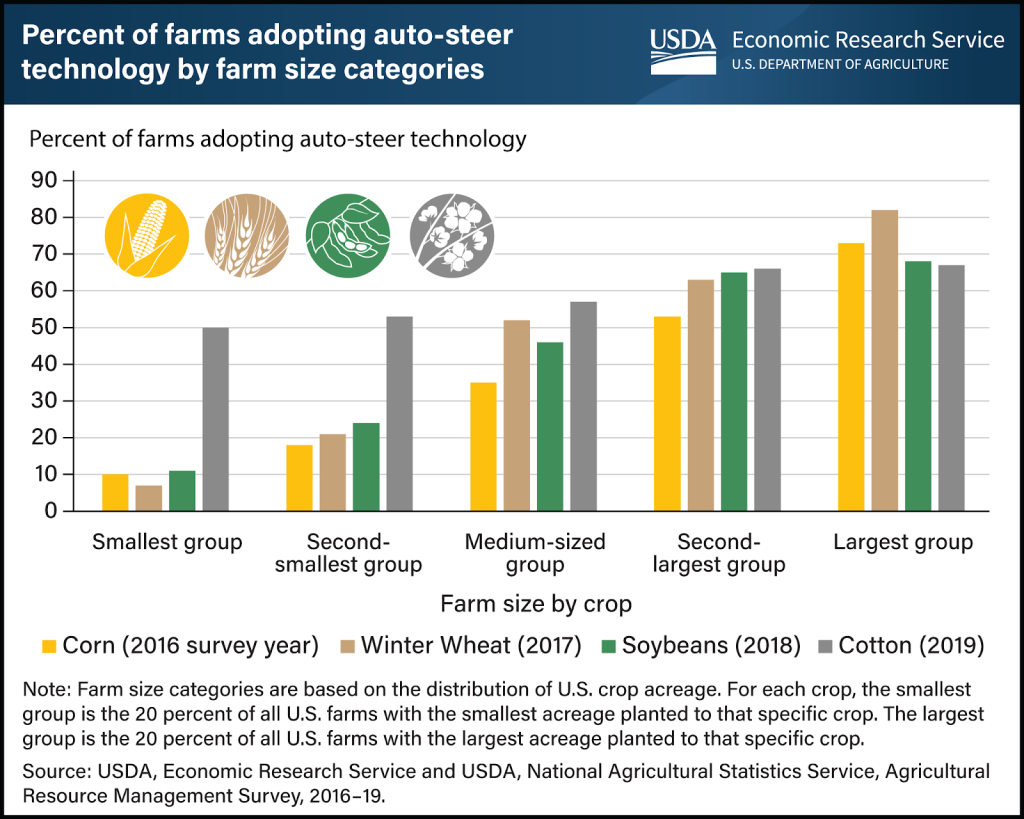
Image: Percent of farms adopting auto-steer technologies
Why? Precision farming tools will reduce input waste while increasing output per acre. Financial systems will use farm data for smarter lending and risk scoring. Climate volatility will be managed through AI-driven alerts and adaptive planning. Agriculture will become data-centered, automated, and resilient.
5 Reasons Why AI in Agriculture Isn’t Optional Anymore
AI in Agriculture is no longer about innovation. It’s about survival. The environment, the market, and the economics of farming have all changed. Here are five clear reasons why adaptation is no longer a choice.
1. Climate Volatility Is Increasing
Weather patterns are unstable. Droughts, floods, and unexpected temperature shifts are more frequent. Traditional seasonal assumptions no longer hold. Agriculture now requires predictive decision-making, not historical guessing. Farms must operate with systems that anticipate risk rather than react to damage.
2. Input Costs Keep Rising
Seeds, fertilizers, fuel, and labor are more expensive than ever. Margins are shrinking. Efficiency is no longer a competitive advantage; it is a requirement. Operations must optimize every resource to remain profitable.
3. Labor Shortages Are Structural
The agricultural workforce is declining in many regions. Skilled labor is harder to secure and more costly. Farms must maintain productivity even with fewer hands available.
4. Food Demand Is Growing
Global population growth and changing consumption patterns are increasing pressure on production systems. Higher output must be achieved without expanding land use at the same pace.
5. Financial and Risk Systems Are Becoming Data-Driven
Lenders, insurers, and investors now rely on measurable performance indicators. Farms that cannot provide structured, data-backed insights may face limited access to capital.
The future of agriculture will be shaped by intelligence, efficiency, and resilience. Those who adapt will lead. Those who delay will struggle to compete.
3 AI Technologies in Agriculture That Are Revolutionary
AI in Agriculture is not one single tool. It’s a stack of technologies working together. Let’s look at the three that are driving the biggest shift.
Computer Vision for Crop Monitoring and Disease Detection
Computer vision in agriculture systems use drones, satellites, and field cameras to scan crops in real time.
AI analyzes plant color, leaf texture, and growth patterns. It detects disease, nutrient deficiency, and pest damage before the human eye can see it.
Early detection means faster action. Faster action protects yield.
This technology reduces inspection time and prevents large-scale crop loss. It turns monitoring from manual scouting into automated intelligence.
Machine Learning for Yield Prediction and Risk Forecasting
Machine learning in agriculture processes historical farm data, weather trends, soil performance, and market patterns.
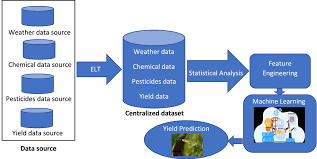
Image collected from Researchgate
It forecasts:
- Expected yield
- Climate impact
- Crop performance
- Input efficiency
Predictive analytics for farming helps farmers make better planting and harvesting decisions. It also strengthens financial planning and risk modeling.
This is where AI moves from reactive farming to strategic farming.
Agricultural Robotics and Smart Automation
Labor shortages are real. AI-driven robotics are filling that gap.
Autonomous tractors, automated weed control systems, and smart harvesters operate with precision and consistency.
These systems reduce dependency on manual labor while improving operational efficiency.
Artificial Intelligence in agriculture is not replacing farmers. It is amplifying their capacity.
Adopting AI in Agriculture: Barriers & How to Overcome Them
AI in Agriculture is powerful. But adoption is not always easy.
Many farms face real barriers. Cost is the first one. AI systems, sensors, and robotics require upfront investment. Small and mid-sized farms often hesitate.
Second is technical knowledge. Artificial Intelligence in agriculture depends on data. Many farmers are not trained to manage digital systems or interpret analytics dashboards.
Third is infrastructure. In rural areas, internet connectivity and reliable power can limit smart farming deployment.
Here’s a simple breakdown:
| Barrier | Impact | How to Overcome |
| High Initial Cost | Delayed adoption | Government incentives, leasing models, agri-fintech financing |
| Skill Gap | Poor system use | Training programs and AI advisory platforms |
| Limited Connectivity | Restricted real-time monitoring | Satellite-based systems and rural broadband expansion |
| Data Trust Issues | Resistance to change | Transparent data policies and local success cases |
The solution is not replacing farmers. It is supporting them.
Public-private partnerships, agrifintech funding, and scalable SaaS-based farm management platforms reduce entry barriers. As AI tools become subscription-based and modular, adoption becomes realistic.
The future of farming is data-driven. Climate volatility, labor shortages, and food demand will not slow down.
The direction is clear, agriculture that integrates AI will adapt. Agriculture that ignores it will struggle.
Soluta in the Future of AI in Agriculture
AI in Agriculture needs structure. That’s where Soluta steps in.
Soluta is building an AI-powered agrifintech platform that connects farm data, financial systems, and climate intelligence into one decision engine. Instead of isolated dashboards, Soluta focuses on integrated insight. Here’s how Soluta comes up with everything farmers need.
- Soluta turns field-level data into structured financial intelligence. Yield patterns, weather shifts, and input usage are translated into risk scores, forecasting models, and performance indicators. This helps farms make stronger operational and capital decisions.
- Soluta strengthens predictive planning. Rather than reacting to crop stress or climate disruption, farms receive forward-looking alerts and scenario analysis. This reduces uncertainty and improves resilience.
- Soluta supports data-backed credit and insurance ecosystems. As lenders and insurers move toward measurable performance metrics, Soluta provides the structured data layer that connects farms to modern financial systems.
Most importantly, Soluta lowers the barrier to AI adoption. Through scalable, modular, SaaS-based architecture, farms do not need massive infrastructure investments to access intelligence-driven systems.
Get Smarter Agricultural Insights With Soluta
Monitor weather, reduce risks, improve farm decisions, and stay ahead with AI-driven agricultural intelligence.
Download the AppFAQs
Is AI in Agriculture only for large commercial farms?
No. While large farms adopted early, AI in Agriculture is becoming more accessible to small and mid-sized farms. Many solutions now operate on subscription models, making them affordable without heavy upfront investment. As platforms scale, entry barriers continue to drop.
How long does it take to see results after adopting AI systems?
It depends on the level of integration. Some benefits, like improved monitoring and faster decision-making, appear within a single growing season. Larger structural gains, such as yield optimization and cost efficiency, often become clearer over multiple cycles as more data is collected.
Does AI replace traditional farming knowledge?
No. Artificial Intelligence in agriculture strengthens traditional expertise. Farmers still make final decisions. AI enhances those decisions with deeper data insights and predictive analysis. Experience combined with data intelligence creates stronger outcomes.
Is data privacy a concern in AI-driven farming?
Yes, and it should be addressed carefully. Farms should choose platforms with transparent data policies and clear ownership terms. Secure systems and trusted partnerships ensure that operational data remains protected while still delivering analytical value.
Will AI make agriculture fully automated in the future?
Automation will increase, but agriculture will not become fully hands-off. Strategic planning, crop selection, and market decisions still require human judgment. AI will act as an intelligence layer that supports, not replaces, agricultural leadership.
Final Words
AI in Agriculture is no longer about staying ahead. It is about staying relevant. Climate pressure, rising costs, labor shortages, and financial accountability are reshaping the industry. Farms now need precision, prediction, and structured decision-making to remain stable.
The shift is not technological alone; it is strategic. Agriculture is becoming data-driven, resilient, and financially connected. Those who embrace this transformation will build stronger, more sustainable operations for the years ahead.